The Role of Transnational Advocacy Networks in United Nations Human Rights Council Resolutions†
Article information
Abstract
This study examines how civil society participation in target and voting states shapes voting behavior in the UN Human Rights Council (UNHRC). Drawing on Transnational Advocacy Network theory, it argues that civil society organizations (CSOs) in target states transmit information on human rights abuses to the international level, while CSOs in voting states translate this information into domestic political pressure. Using data on target-state CSO complaints submitted to the UN Special Procedures (UNSP) and measures of voter-state civil society participation from V-Dem (2025), the study analyzes UNHRC voting outcomes from 2009 to 2022 using a binary logistic regression. The results show that a higher number of CSO complaints against a target state increases the likelihood of affirmative votes, and this effect is significantly stronger when voting states have more active civil societies. These findings provide empirical evidence that transnational advocacy networks operate within the UNHRC, showing that civil society influence originating in target states is transmitted into international decision-making processes and becomes more effective when supported by active civil society in voting states.
1. Introduction
Under what conditions do member states of the UN Human Rights Council (UNHRC) increase their support for human rights resolutions? This paper answers this question by focusing on target states’ civil society and voting states’ domestic political environment.
In today’s global landscape, civil society organizations (CSOs) often act as agenda-setters. They use information to draw the attention of international organizations (IOs) to crises that were previously ignored. The digital age has expanded this capacity. Information on human rights abuses can now spread globally at high speed (Hall et al 2020). The persecution of the Rohingya in Myanmar illustrates this dynamic. Local activists used social media to broadcast atrocities to the world. This surge of information, carried through transnational networks, helped move the issue onto the UNHRC agenda. It shows how CSOs can supply the informational “raw material” for international action.
At the same time, domestic civil society action faces a paradox. Many CSOs operate under systematic constraints. The European Union Agency for Fundamental Rights (FRA) documents that civic space is under constant threat. A 2020 report finds that CSOs across Europe repeatedly face “complex registration procedures, unstable funding, direct or indirect political pressure from public authorities, and online attacks”. These limits imply that strong domestic activism alone may not translate into international support for human rights norms. It may even be ineffective or counterproductive when isolated from broader leverage (Tarrow, 2005).
Given these constraints, this study examines how civil society participation in target and voting states shapes voting behavior in the UNHRC. Pressure from CSOs in the target state must be matched by a receptive and active civil society in voting states. Together, these forces can generate stronger domestic pressure for supportive votes. This argument draws on the literature on Transnational Advocacy Networks (TANs), which explains how activists and CSOs coordinate across borders to influence state behavior.
By integrating this framework with a quantitative analysis of UN Special Procedure (UNSP) CSO complaints and resolution voting, this paper examines how transnational advocacy influences UNHRC decision-making. The empirical results show that when CSO complaints from the target state increase, the likelihood of a positive vote in favor of resolution also rises. Moreover, this effect becomes significantly stronger when the voting state has an active civil society at home.
This study offers broader implications for research on UN politics and transnational advocacy. By statistically linking civil society activity in both target and voting states to measurable shifts in state positions, the study extends the classic TANs/boomerang framework and shows that a central part of the mechanism operates through voter states, where governments ultimately decide whether to support scrutiny. It also clarifies multi-level governance as a connected chain in which information and pressure travel from target-state CSOs through international institutions and into the domestic politics of voting states, reappearing as institutional pressure within the UNHRC. At the same time, these findings imply shared responsibility across actors: CSOs should continue to document and transmit credible information; pro-rights actors in voting states should translate that information into domestic accountability pressure; and international institutions should keep channels open to diverse civil society participation so that the human rights regime remains responsive rather than symbolic.
In this paper, the term CSO is employed in place of NGO, encompassing charities, community groups, religious organizations, and other non-state actors engaged in transnational advocacy. This terminology provides a more comprehensive basis for examining how diverse civil society networks influence state behavior within the UNHRC, particularly in light of the diversity of submitters in UNSP complaints. This approach is consistent with Steinert and Smidt (2025), who likewise adopt an expansive definition of CSOs to account for the wide range of actors engaged in the UNSP complaint process.
2. Materials and Methods
Theory
The human rights literature has been broadly divided into two strands. One of them is optimistic perspective forming the theoretical foundation of the this study. This strand emphasizes the positive role of international and transnational networks in facilitating the diffusion of human rights norms and enabling international advocacy (Risse, Ropp, and Sikkink 1999). On the same context, Keck and Sikkink (1998) argued the significance of TANs, defined as cross-border coalitions of NGOs, activists, and professional organizations that mobilize around shared values and human rights norms.
This perspective helps interpret the pattern shown in Figure 1, which indicates that periods of stronger civil society presence are associated with higher levels of support for human rights resolutions. This pattern reflects the boomerang effect, a core mechanism through which TANs translate civil society pressure into state behavior within international institutions.
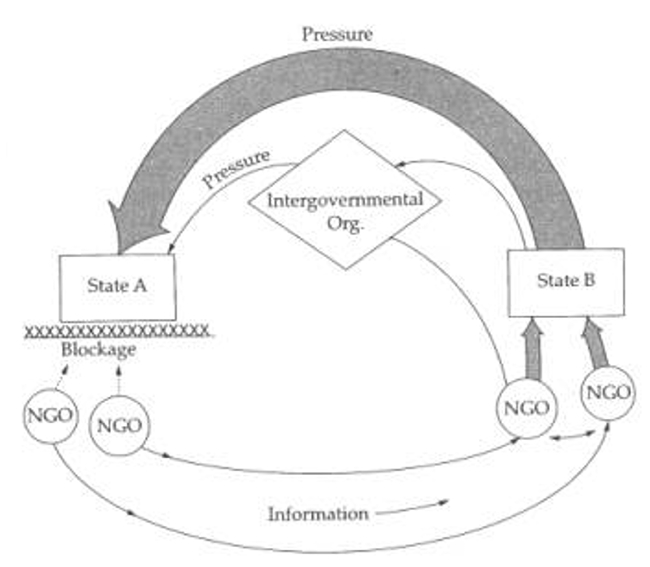
Stages of Transnational Advocacy Networks (Kick & Sikkink 2018).
It presents the boomerang effect, highlighting how international organizations are strategically leveraged within transnational advocacy networks. Unlike the original formulation, this revised figure makes explicit the mediating role of intergovernmental organizations in converting transnational information flows into political pressure.
In this model, NGOs operating in State A face domestic blockage, which prevents them from directly influencing their own government. As a result, these NGOs redirect their advocacy outward by transmitting information on alleged human rights violations through institutionalized reporting channels, such as individual communications to the UNSP. These mechanisms allow localized claims to be formally documented and circulated within the UN human rights system. Civil society actors and NGOs in State B, benefiting from greater political access and responsiveness, can then use this information to mobilize their own governments within the UNHRC.
Through deliberation, agenda-setting, and voting processes at the UNHRC, information initially produced by NGOs in State A is transformed into collective political pressure. Member states such as State B may raise concerns during interactive dialogues, support country-specific resolutions, or reference UNSP communications as authoritative sources of concern. In this process, international organizations function not merely as neutral forums but as amplifiers that aggregate information, confer legitimacy, and translate civil society reports into reputational and diplomatic costs.
Pressure is subsequently exerted back onto State A through multiple channels, including public scrutiny in UNHRC sessions, repeated references to UNSP communications, and the prospect of adverse resolutions or follow-up monitoring. In this sense, transnational advocacy does not bypass international organizations but instead strategically relies on institutional mechanisms within the UN human rights regime as leverage points, enabling civil society actors to overcome domestic political constraints and influence state behavior indirectly.
Building on this mechanism, this study argues that the effectiveness of transnational advocacy varies systematically with the configuration of civil society in both target and voter states. Specifically, while civil society activity in the target state generates information through channels such as UNSP complaints, the extent to which this information translates into political pressure depends on the level of civil society participation in voter states. Here is the posited hypothesis.
H1. The higher the number of CSO complaints filed against a target country, the more likely UNHRC member states are to vote Yes on the resolution.
Target state civil society plays a crucial role in amplifying international information domestically, mobilizing governments within the UNHRC, and shaping states’ voting behavior on human rights resolutions. The complaints filed by CSOs against target states activate civil society networks within voting states, reconstructing the very environment in which policymaking occurs.
In the short-term process, civic groups and engaged publics translate global human rights norms into domestic pressure, imposing relational and reputational costs on policymakers and raising the political costs of opposing human rights initiatives. At the same time, supporting international resolutions becomes a marker of normative legitimacy, prompting reputation-sensitive policymakers to align with pro-human-rights positions; these domestic pressures are then transmitted through the foreign policy apparatus to Geneva missions, ultimately shaping diplomatic voting behavior.
In the long-term process, sustained civic engagement stimulates domestic debate on human rights issues, with TANs and domestic civil society playing critical roles as states move through the five stages of Risse, Ropp, and Sikkink's (1999) spiral model—repression, denial, tactical concessions, prescriptive status, and rule-consistent behavior. In the early stages, TANs expose violations and mobilize international attention, pushing governments from denial toward tactical concessions, while domestic civil society becomes increasingly empowered to hold governments accountable, forming a feedback loop in which international commitments provide leverage for domestic actors who in turn demand consistent implementation.
As a result of this bottom-up process, states with vibrant civil societies and strong TAN linkages undergo an identity shift toward supporting human rights resolutions, leading to the second hypothesis as follows.
H2. As civil society participation in the voter state increases, the positive effect of target-state CSO complaints on the likelihood of a Yes vote becomes stronger.
Materials
The dependent variable is state voting behavior on UNHRC resolutions. It draws on data originally compiled by Kim (2025), covering 97 countries and 1,407 country-specific resolutions debated in the UN Human Rights Council from 2009 to 2022. The unit of analysis is a resolution–voting state dyad, capturing how each UNHRC member state voted on a given resolution over time. In the original dataset, voting outcomes were coded on an ordinal scale: 1 (No), 2 (Abstain), 3 (Yes), and 4 (No Vote). The “No Vote” category reflects procedural absences, temporary suspensions, or technical non-participation. These cases were excluded because they are driven by administrative circumstances rather than substantive political positions. Keeping them would blur the policy preferences expressed through active voting.
The first independent variable, CSO complaints, captures the number of human rights complaints filed by CSOs in each country through the UNSP mechanism1. These complaints indicate the extent to which domestic civil society actors channel local grievances into international human rights processes. It is necessary to clarify, however, that these complaints are not necessarily filed directly by CSOs toward the Target State. Nevertheless, this study analyzes this variable by treating the complaints as explicitly targeting the target state. The rationale for this is twofold: First, in the majority of cases, the underlying grievances originate from human rights violations within the target state itself. Second, even when complaints are filed from abroad, they are typically made by small diaspora or exiled civil society groups originating from the target country, which still serve the function of channeling domestic grievances into international processes. For the purposes of this study, the analysis focuses on thematic mandates.
A second independent variable measures the domestic civil society environment within voting states. Drawing on V-Dem (2025)’s Civil Society Participation index, this variable captures the extent to which citizens and organizations in voting countries participate in public life and are able to mobilize collectively. In this study, CSOs include, but are not limited to, interest groups, labor unions, spiritual organizations engaged in civic or political activities, social movements, professional associations, charities, and other non-governmental organizations. The index combines information on whether major CSOs are routinely consulted by policymakers, how widespread citizen involvement in voluntary associations is, the degree to which women are able to participate in civil society on equal terms, and whether candidate nomination within parties is decentralized or takes place through party primaries. Taken together, these components reflect the density, inclusiveness, and political relevance of associational life in each country.
The control variables in this study are constructed as follows. To account for regional bloc dynamics, a regional alignment dummy variable is included, coded 1 when the voting state and the target state belong to the same UNHRC regional group. To capture the political and institutional environment of the voting state, three additional controls are incorporated: the Human Rights Index from V-Dem, a binary democracy variable recoded from the Liberal Democracy Index, and the UNGA Ideal Point Distance drawn from Voeten (2009), which measures ideological divergence in foreign policy preferences between the voting and target states. Finally, log-transformed GDP per capita is included to control for economic capacity and overall development level.
Methods
To empirically analyze how transnational civil society engagement shapes states’ positions on UN human rights resolutions, this study employs a quantitative research approach focusing on the voting behavior of member states in the UNHRC. The main analysis uses a binary logistic regression (logit) model to test the core hypotheses. The dependent variable is recoded into a binary indicator distinguishing “Yes (1)” from “No and Abstain (0)”. This recoding reflects the substantive distinction between states that actively support a resolution and those that withhold support, either by opposing or abstaining.
This study recodes the original dependent variable into a binary measure: values of 1 and 2 (no and abstain) are collapsed into 0, while the value of 3 (yes) is retained as 1. This recoding reflects the logic of consensus-based decision-making prevalent in UN settings, where most states adopt resolutions without active opposition, a practice that does not necessarily indicate genuine endorsement. Consequently, the symbolic significance of no and abstain votes becomes comparatively more meaningful as indicators of deliberate dissent.
In the specification above, the dependent variable is modeled as the probability of a supportive vote. All covariates are lagged by one year to ensure proper temporal ordering and reduce simultaneity concerns, such that most variables enter the model. Standard errors are clustered at the voter level to accommodate within‐voter serial correlation and cross‐resolution dependence, thereby producing more reliable inference.
Year fixed effects control for period-specific political shocks that commonly affect all UNHRC member states, such as changes in the international political environment. Resolution fixed effects absorb unobserved, time-invariant characteristics inherent to individual resolutions, including issue salience and drafting patterns, while target-state fixed effects control for persistent features of target states that systematically shape voting behavior.
As a result, resolutions that receive unanimous support or opposition across member states are automatically excluded in statistical identification once resolution fixed effects are included. Accordingly, the analysis focuses on contested resolutions, where variation in voting behavior allows the influence of civil society to be meaningfully evaluated.
3. Results
This study examines how civil society influences member states’ voting behavior on UNHRC resolutions. Model 1 is estimated using a logit specification, while Model 2 introduces an interaction term to test the conditional effect of domestic civil participation. Table 1 reports the results for Hypotheses 1 and 2. Overall, the findings provide strong support for both hypotheses.
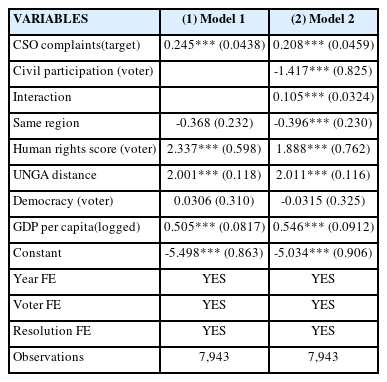
Results for Hypotheses 1 and 2
First, CSO complaints regarding human rights violations in target states exhibit a positive and statistically significant effect across both models. In Model 1, an increase in CSO complaints is associated with a higher likelihood that UNHRC member states vote in favor of the corresponding human rights resolution. This result remains robust in Model 2 after accounting for domestic civil participation in the voting state. Substantively, this finding suggests that civil society reporting increases the international visibility of human rights abuses and facilitates agenda-setting within the UNHRC, thereby mobilizing support for collective action.
Second, Model 2 shows that the interaction between CSO complaints and the level of civil participation in the voting state is positive and highly significant, lending strong support to Hypothesis 2. While the coefficient for civil participation alone is negative, the positive interaction term indicates that CSO complaints become more influential as civil participation in the voting country increases. In other words, where domestic civil society is more active and participatory, governments are more responsive to information and pressure generated by transnational civil society networks. This pattern is consistent with the logic of TANs, whereby local claims originating in target states travel through international civil society channels and are reinforced by civic engagement within voting states, ultimately shaping state behavior inside the UNHRC.
Finally, economic capacity also matters. Higher GDP per capita is positively associated with supportive voting behavior, implying that wealthier states may face lower political or material costs when endorsing human rights scrutiny. In contrast, democracy status in the voting state does not show a statistically significant independent effect, suggesting that civil society channels play a more direct role in shaping voting outcomes.
Taken together, the results highlight the central role of civil society in international human rights politics. Civil society influences UNHRC decision-makisng not only directly, through the documentation of human rights abuses, but also indirectly, through cross-border linkages that amplify pressure when domestic civic engagement in voting states is high. These findings underscore the importance of transnational civil society networks in sustaining and enforcing human rights norms within international institutions.
Figure 2 shows that the influence of target-state CSO complaints depends strongly on the level of civic engagement in the voting state. When civic participation in the voting state is low, additional CSO complaints have little to no effect on support for human rights resolutions, with marginal effects close to zero. As civic participation strengthens, the effect of CSO complaints becomes clearly positive and statistically significant. In voter states with strong civic engagement, each additional CSO complaint raises the probability of a supportive vote by roughly 1 to 1.3 percentage points. At moderate levels of participation, the increase is about 0.5 percentage points, while at high and very high participation levels, the effect grows to approximately 0.9 and 1.3 percentage points.
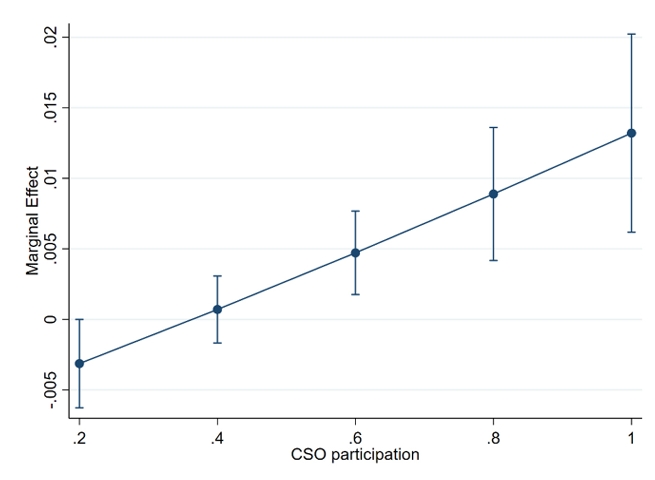
Marginal Effects.
Turning to the predicted probabilities in Figure 3, we can more directly observe how the impact of CSO complaints on voting behavior differs by the level of civic engagement in voter states. When there are no CSO complaints, the probability of a Yes vote is about 64 percent, but as complaints increase to 35, this probability declines to approximately 58 percent. By contrast, under conditions of high civic participation, with 20 complaints, the predicted probability of a Yes vote increases to approximately 66 percent, and with 35 complaints, it rises further to nearly 74 percent.
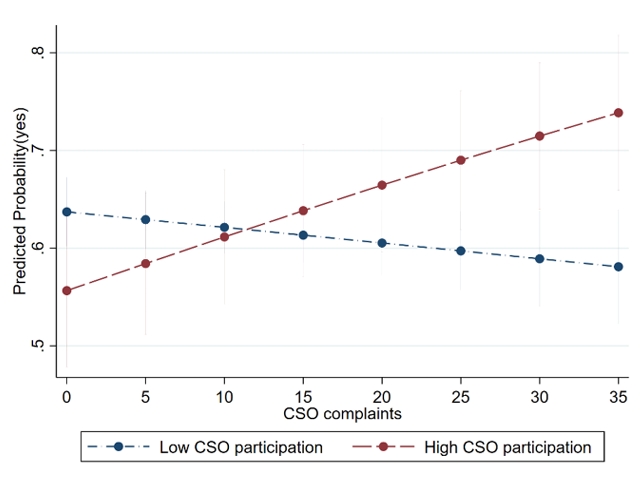
Predicted Probabilities of Resolutions.
Substantively, this implies that CSO complaints translate into more Yes votes only when voter states possess strong domestic civic participation. In highly participatory contexts, moving from no complaints to sustained civil society pressure corresponds to an increase of nearly 18 percentage points in the probability of a Yes vote, whereas in low-participation states, the same increase in complaints is associated with a 6-percentage-point decline in Yes votes. This suggests that policy-makers in participatory contexts internalize civic pressure into their foreign policy, otherwise, without free civic engagement, the likelihood of voting in favor of human rights resolutions tends to decline.
4. Discussion and Conclusions
This study empirically analyzes how civil society strategically influences voting behavior on UNHRC resolutions. By using a Binary Logit model, this research finds that civil society activities in the target state positively influence the likelihood of supportive votes at the UNHRC. The interaction model further demonstrates that as CSO complaints increase and simultaneously, when the voting state exhibits higher levels of domestic civic engagement, the probability of casting a supportive vote rises substantially. These findings provide systematic empirical evidence that TANs operate effectively within the HRC context, shaping states’ decisions through cross-border civil society pressure.
This study offers three main implications. First, this study provides statistical evidence that transnational advocacy dynamics shape UNHRC resolution voting. It extends the classic TAN/boomerang framework (Keck & Sikkink, 1998) by showing that the mechanism does not stop at the target state: it also runs through voter states, where governments decide whether to support or resist scrutiny. Because civil society influence is observable inside the HRC, protecting the human rights regime requires sustained and active international engagement by civil society actors of both target and voter countries.
Second, the findings demonstrate that political contestation in the human rights regime can be shaped, and even reinforced, through the interaction strategies employed by civil society actors. Issues that fail to achieve consensus in UNHRC are, by definition, politically sensitive for member states. It is therefore notable that civil society influence operates across this threshold, suggesting that non-state actors retain meaningful leverage even on contentious agenda items. This is more significant given that such influence can often be traced to localized grievances initially brought to the UNSP complaints.
Third, the findings clarify multi-level governance as a connected sequence: pressure travels from target-state CSOs through international institutions into voter-state domestic politics, and returns as institutional pressure within the UNHRC. This shows that civil society-driven information and mobilization can generate cooperation and conflict beyond state interests alone. Sustaining this multi-level governance also requires effort from global citizens, whose attention and participation help keep institutions responsive.
However, the study has three key limitations. First, UNHRC voting data raises a selection concern: most resolutions pass by consensus, and recorded votes typically occur only on politically contested items; moreover, fixed-effects models mechanically exclude resolutions with little or no within-resolution variation (including near-unanimous outcomes). As a result, the analysis may not fully reflect the Council’s broader voting practice. Second, the study focuses on international voting outcomes and does not trace whether resolutions generate subsequent improvements within target states, leaving the final stage of the boomerang effect untested. Third, the analysis does not examine governments’ strategic responses to external pressure, including whether international scrutiny prompts stronger restrictions on domestic CSOs that could dampen advocacy efforts.
Future research should proceed in three directions: first, it should address the selection problem in UNHRC recorded votes with appropriate statistical approaches that model which resolutions reach a vote; second, it should trace whether and how resolutions produce positive changes within target states after adoption; and third, it should test how domestic civil society repression conditions (or counteracts) these effects, including whether repression dampens advocacy or triggers adaptive strategies and backlash dynamics.
Taken together, these results show that international human rights politics are shaped not only by states but also by the networks that connect civil society across borders. Transnational advocacy can transform local struggles into international concerns that governments must address. Even as illiberal pressures persist, cooperation among civil society actors continues to open space for accountability and human rights protection. The future of the human rights regime will depend on their ability to keep mobilizing, adapting, and sustaining influence within international institutions.
Notes
1Information on complaints submitted to the UN Special Procedures is publicly accessible through the OHCHR Special Procedures Communications Database (OHCHR, November 24, 2025). As of November 2025, the Special Procedures mechanism comprises 46 thematic mandates and 13 country mandates (OHCHR, November 19, 2025). Mandate holders perform several core functions: drawing attention to alleged human rights violations, issuing communications to governments and other relevant actors, and producing reports on such violations (OHCHR, November 19, 2025; OHCHR, December 1, 2025).